

-
By test
-
February 8, 2024
- 0 Comment
The Last Secret in Your Glass
Pour a great whisky, a smooth rum, or a crystal-clear vodka, and you’re looking at the result of a process most drinkers never think about. Before that spirit reaches the bottle, it passes through a carefully orchestrated sequence of filters, each one silently doing its job so that what lands in your glass is exactly what the master distiller intended.
“"Distillers spend years perfecting their grain bill, their fermentation, and their aging. But the final quality of the liquid, its clarity, its color, and its character, lives or dies in the filtration stage.
Why Filtration Actually Matters
Raw distillate is not a finished product. Even after years in an oak barrel, a spirit carries with it char particles, haze-forming proteins, microscopic organic compounds, and the occasional mineral or lipid that has no business being in the final bottle. Left unaddressed, these elements lead to a hazy appearance, off-flavors, unpredictable shelf stability, and, in the worst case, microbial spoilage that can ruin an entire batch.
Filtration is not just about aesthetics. It is about consistency, safety, and delivering on the promise of every label. The distiller’s art ends at the still; filtration is where that art becomes a reliable, repeatable product.
Even a small amount of bacterial contamination can compromise an entire batch, making sterile-grade filtration and rigorous sanitation protocols non-negotiable for serious producers.
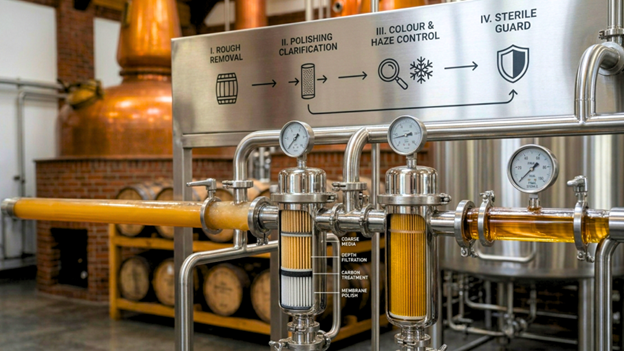
The Four Stages of the Distillery Process
Modern spirit production follows a logical filtration sequence. Each stage addresses a different scale of contaminant, and each requires a different filtration technology.
Coarse Filtration
The first pass. Removes large visible particulates, char debris, suspended solids, and any macro-level “hitchhikers” that rode the liquid out of the barrel or still are in it. Bag filters are the workhorses here.
Barrel Char Removal & Particulate Reduction (Post-Ageing)
After years in an oak barrel, the spirit needs targeted cleanup. Charred wood fragments, color compounds, and barrel-derived particulates must be removed without stripping the character the barrel imparted.
Chill Haze / Clarification
When spirits are chilled below a certain temperature, fatty acids and proteins can form a visible haze. This stage captures those compounds using depth filtration media, preserving brightness at all serving temperatures.
Final Filtration (Pre-Bottling)
The guard stage. A final membrane filter acts as an absolute barrier, catching any residual particles, bioburden, or trace contamination before the spirit is sealed and shipped. This is where “sparkling clarity” becomes a guarantee, not a hope.
Matching the Right Filter to Every Stage
Not all filters are equal, and using the wrong technology at any stage means either over-filtering (stripping flavor) or under-filtering (missing contaminants). Here’s how the right tools map to the right jobs:
Stage | Filter Type | Why It Works |
Barrel Char Removal | Flow-Pure Bag Filter | Captures large char pieces and visible particulates at high flow rates with minimal pressure drop. |
Chill Haze / Clarification | Flow-MAX Pleated Cartridges | Tortuous media structure captures a wide range of particle sizes with excellent dirt-holding capacity, available as melt-blown or pleated. |
Intermediate to Final Clarification | Carbon Lenticular Filters | Depth filtration in an enclosed cartridge format, highly effective for turbidity reduction and removing fine hazes and particulates. |
Final Guard (Pre-Bottling) | PES Membrane Filters | Absolute barrier filtration for the final polish. Ensures a sparkling, clear product with consistent microbial control. |
All of the above are compatible with CIP/SIP (Clean-in-Place/Steam-in-Place) protocols and standard distillery housings, critical for maintaining hygiene without lengthy production downtime.
The Challenges That Keep Distillers Up at Night
Process & Operational Challenges
High particulate loads clog filters quickly, raising operating costs and causing unplanned downtime. Contaminant variability between batches means a one-size-fits-all approach rarely works. Add in the viscosity changes at different temperatures and the challenge of balancing throughput with quality, and it’s clear that filtration is an engineering discipline, not just a housekeeping task.
Product Quality & Consistency
Haze is the enemy of shelf appeal, and it’s not always obvious until the bottle is already cooled in a retailer’s display. Specific minerals and organic compounds carried over from the source water or the barrel can cause quality issues that are notoriously hard to trace. Achieving batch-to-batch consistency demands a robust, validated filtration process rather than a reactive one.
Microbial Contamination
Despite the alcohol content, spirits are not immune to microbial contamination, particularly at lower ABV ranges or in dilution water. Even small bacterial counts can compromise a batch, trigger product recalls, and cause serious reputational damage. Sterile-grade membrane filtration at the pre-bottling stage is the last and most critical line of defense.
The best distilleries treat filtration the same way they treat their recipe, with obsessive precision, documented procedures, and validated results at every stage.
What Great Filtration Looks Like in Practice
A well-designed filtration system for a distillery should accomplish a few things simultaneously: it should protect product quality without stripping character; it should be easy to clean and validate; it should scale with production volumes; and it should fail gracefully, alerting operators before a problem becomes a recall.
This means thinking beyond individual filter cartridges and considering the full system, housing compatibility, CIP/SIP capability, differential pressure monitoring, and change-out frequency. It means choosing filter media that has been validated for food-grade spirit contact and extractables. And it means working with filtration partners who understand the specific demands of the beverage alcohol industry, not just general industrial filtration.
The spirits that win awards and build loyal followings are rarely the ones that cut corners in processing. Behind every clean, consistent, beautiful bottle is a filtration process that was taken seriously from the coarse pre-filter all the way to the final membrane.
Looking to Upgrade Your Process?