

-
By test
-
February 8, 2024
- 0 Comment
How to Choose the Right Filters for Your Process
In the high-stakes world of large-scale manufacturing, purity is not just a preference; it is a requirement. Whether you are managing a chemical plant, a food processing facility, or a pharmaceutical laboratory, the presence of contaminants in your process fluids can lead to catastrophic equipment failure, compromised product quality, and expensive downtime.
However, choosing the appropriate process-grade filtration setup is not always a straightforward decision. With a vast array of technologies available, from simple bag filters to complex multi-stage setups, making an uninformed choice can be a costly mistake. For plant managers and process engineers, the goal is to find a balance between high-efficiency purification solutions and operational cost-effectiveness.
This guide explores the technical nuances of choosing the ideal fluid separation system and how the right technical filtration hardware can transform your production efficiency through properly engineered liquid filtration process systems.
Why Process Filtration Matters
“Implementing a robust facility-scale filtration setup is a strategic investment in the longevity of your facility. Beyond simply "cleaning" a fluid, filtration serves several core business functions.
Equipment Protection
Downstream components like high-pressure pumps, spray nozzles, and heat exchangers are highly sensitive to particulate matter. Without a proper specialized filter setup for manufacturing, abrasive particles can cause erosion, clogging, and mechanical seal failure. By installing a high-quality purification assembly, you extend the Mean Time Between Failures (MTBF) for your most expensive assets.
Product Quality
In sectors like the chemical industry or beverage production, even microscopic contaminants can result in an entire batch being rejected. Consistent high-performance filtration solutions ensure that your end product meets the rigorous quality benchmarks expected by your clients and end-users.
Process Efficiency
A well-designed filtration setup maintains optimal flow rates and reduces the frequency of maintenance shutdowns. When you minimize the pressure drop across your system, you reduce energy consumption and maximize throughput. Liquid filtration process systems that are correctly sized allow for longer run times and fewer interruptions.
Regulatory Compliance
Environmental and safety regulations, such as those from the EPA or FDA, require strict adherence to fluid purity standards. Effective filtration helps in meeting discharge standards and ensures that process fluids are safe for both the workforce and the environment.
Key Factors to Consider When Choosing a Filtration Assembly
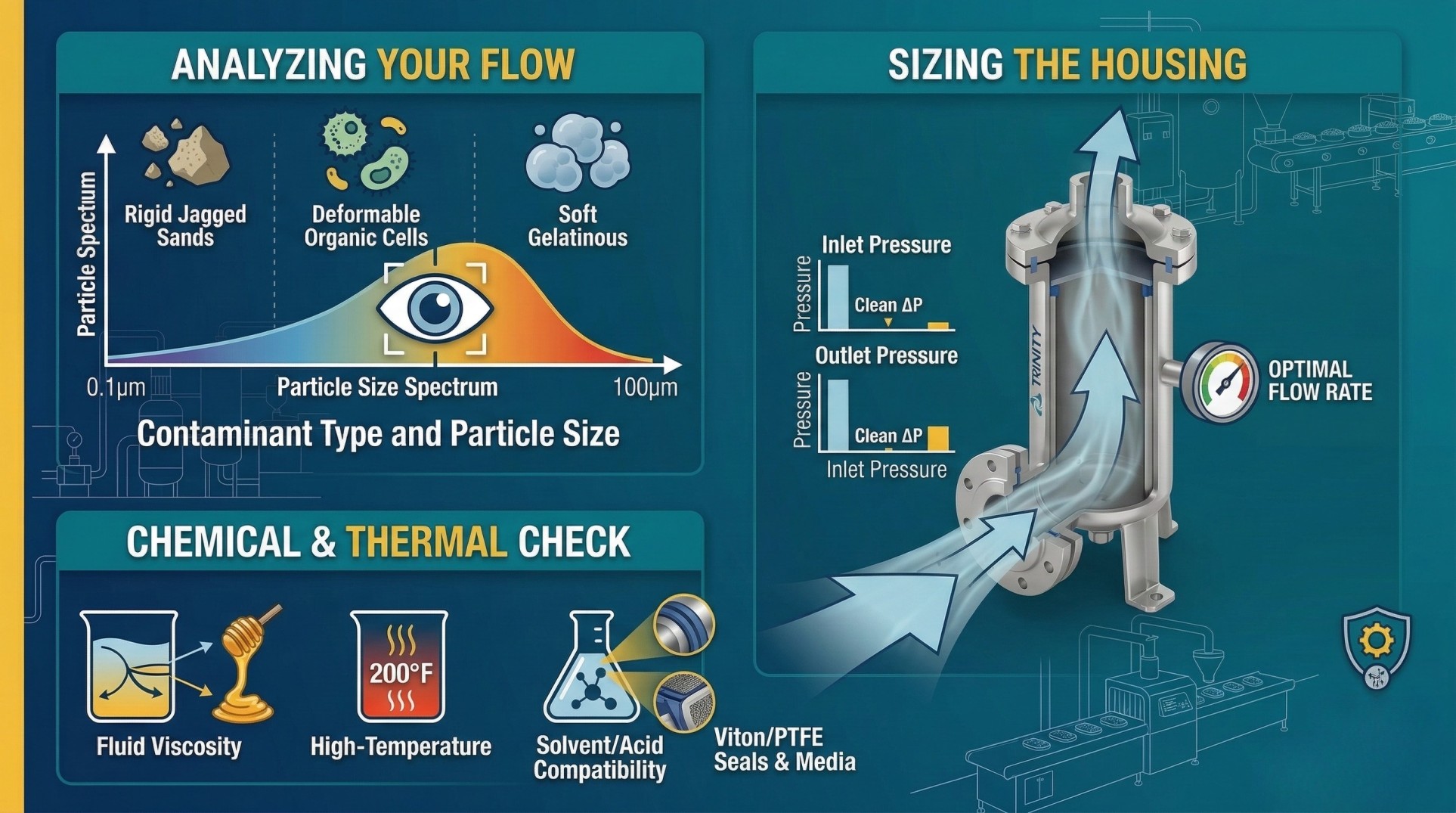
To determine how to choose components that actually work for your specific application, you must evaluate several technical variables.
Contaminant Type and Particle Size The first step is a thorough analysis of the “dirt” you are trying to remove. Are the contaminants rigid, deformable, or organic? Understanding the particle size distribution (PSD) allows you to select a micron rating that captures the harmful particles without clogging prematurely. For example, rigid sand particles are handled differently than soft, gelatinous organisms.
Flow Rate Requirements Your filtration hardware must handle the maximum flow rate of your process without causing a significant bottleneck. It is essential to size the housing and the media to accommodate peak flows while maintaining a low “clean pressure drop.” If the flow velocity is too high, it can force contaminants through the media, compromising the integrity of the fluid management system.
Fluid Properties The “chemistry” of your process dictates the material of your filter. Consider these three factors:
- Viscosity: Thicker fluids (like resins or heavy oils) require more pressure or larger surface areas to pass through a filter media.
- Temperature: High-temperature processes require specialized metallic or high-grade polymer housings to prevent thermal degradation.
- Chemical Compatibility: You must ensure the filter media and seals (O-rings) don’t degrade when exposed to aggressive solvents or acids.
For high-viscosity fluids like resins or syrups, we typically recommend high-surface-area pleated cartridges to maintain flow without excessive pressure build-up.
When handling aggressive solvents in chemical processing, ensuring that the O-rings and media are made of Viton or PTFE is critical to prevent bypass leakage.
Filtration Efficiency and Micron Rating The micron rating indicates the size of particles the filter can trap. However, it is vital to distinguish between nominal (roughly 60–80% efficiency) and absolute (99.9% efficiency) ratings. Using an absolute-rated filter for a pre-filtration stage is often an unnecessary expense, while using a nominal filter for final polishing can lead to quality failures in your liquid filtration process systems.
Maintenance and Filter Life
How often can you afford to change the filter?
High-capacity filtration solutions, like Trinity’s pp pleated cartridges, extend the intervals between service interruptions and reduce the “Total Cost of Ownership” (TCO).
Types of Filtration Technologies
At Trinity Filtration Technologies, we provide a diverse range of hardware designed to meet specific engineering challenges. We engineer our products to achieve maximum efficiency while requiring minimal maintenance.
Filter Type | Key Applications | Primary Benefit | Notable Series / Features | Target Contaminants |
Cartridge Filter | Pharmaceutical, Electronics | High purity & fine filtration | Trinity Melt Blown (depth), Trinity Pleatmaster (pleated) | Fine particulates, high dirt loading |
Bag Filter | Wastewater, Paint/Coating | Cost-effective for high-flow | Trinity Sentinel Housings (easy change-outs) | Larger particulate loads |
Multi-Stage Filter | Complex Industrial Processes | Protects expensive final-stage filters | Combination of media (e.g., Bag + Cartridge) | Progressive removal (coarse to fine) |
Activated Carbon Filter | Chemical, Water Purification | Chemical purity (removes odors/colors) | Adsorption of dissolved organic chemicals | Odors, colors, dissolved organics |
Membrane Filter | Biotech, Beverage | Sterile outcomes (sub-micron) | Trinity PES & PTFE Series (precise pore structure) | Bacteria, viruses, sub-micron particles |
Industry-at-a-Glance
Industry | Typical Application | Recommended Trinity Hardware |
Oil & Gas | Amine and Glycol filtration | High-Flow Pleated Cartridges |
Food & Beverage | Polishing syrups and juices | Trinity Sentinel Bag Housings |
Paints & Coatings | Removing “fish-eyes” and gels | Pleatmaster Series or Nylon Mesh Bags |
Water Treatment | Pre-RO (Reverse Osmosis) protection | Melt Blown Depth Cartridges |
Common Mistakes When Selecting Filters
Even experienced engineers may encounter common pitfalls when procuring technical filtration hardware.
- Wrong Micron Rating: Selecting an overly fine filter increases pressure drop and replacement frequency without adding functional value.
- Ignoring Pressure Drop: Delta P is critical; neglecting it can cause the system to reach terminal pressure almost immediately, halting production.
- Choosing Based on Price Only: A cheaper filter often has a lower dirt-holding capacity, meaning you spend more on labor and replacements in the long run.
- Incompatible Materials: Using a standard seal in a solvent-heavy process can cause the seal to swell and leak, leading to contamination bypass in your liquid filtration process systems.
How Custom Solutions Improve Process Efficiency
Standard, off-the-shelf filters often fail to meet the specific demands of a unique manufacturing process. This is where custom solutions from Trinity Filtration Technologies provide a competitive edge. We view filtration as a three-stage journey:
- Pre-Filtration: This phase is the “heavy lifting” stage. By using robust bag filters or coarse depth cartridges, we remove the bulk of the contaminants. This procedure protects the more expensive downstream equipment and ensures the main filtration stage can function at peak efficiency.
- Main Filtration: This phase is where the target purity is achieved. Whether it’s using Trinity High-Flow Cartridges for large volumes or specialized pleated media, this stage is tailored to the exact micron requirement of your process. This part is the core of most liquid filtration process systems.
- Post-Filtration: The final “polishing” or sterilization stage. Using Membrane Filters or activated carbon, we ensure that the fluid leaving the system is of the highest possible quality, free from even the smallest traces of impurities or odors.
Tailored process purification strategies perform better because they are engineered for your specific flow rates and contaminant profiles, which allows for more efficient removal of impurities and ensures optimal fluid quality in the final output. Filtration Technologies naturally integrates these stages into a seamless, high-performance skid or housing assembly that minimizes waste and maximizes uptime.
Conclusion
Choosing the right filtration configuration is a balance of science, engineering, and strategic procurement. By understanding your contaminant profile, flow requirements, and fluid chemistry, you can select technical purification solutions that do more than just clean a fluid; they optimize your entire production line.
A successful manufacturing operation relies on a process-grade system that protects expensive machinery and ensures regulatory compliance. High-performance liquid filtration process systems ensure that your plant remains competitive and efficient in a demanding market. Don’t rely solely on chance to maintain the purity of your process.
Are you ready to optimize your process? Contact the experts at Trinity Filtration Technologies today for a technical consultation. Our team of engineers will help you design and implement the perfect filtration assembly tailored to your specific needs.
FAQ'S
A nominal rating refers to the filter’s ability to trap a percentage of particles of a certain size (e.g., 80% of 5-micron particles). An absolute rating means the filter captures 99.9% or more of particles at that size, providing a much higher level of precision for critical filtration hardware.
The most reliable way is to monitor the pressure drop (Differential Pressure or Delta P). When the pressure difference between the inlet and outlet reaches a specific threshold (usually 15–25 psi depending on the housing), it indicates the filter is saturated and needs replacement to maintain efficient liquid filtration process systems.
In many cases, yes, provided the housing dimensions (222 or 226 O-rings, DOE, etc.) are compatible. However, it is always best to consult with a provider like Trinity Filtration Technologies to ensure that the flow dynamics and chemical compatibility remain optimal for your process-scale filtration setup.
This is usually due to an increase in contaminant loading or an incorrect micron rating for the pre-filtration stage. If your initial stage is inadequate, the main filter will “blind” or clog prematurely. A multi-stage filtration architecture can solve this issue by spreading the load.
While the initial investment in a custom process-grade system may be higher, the “Total Cost of Ownership” is typically much lower. Custom liquid filtration process systems provide longer filter life, better equipment protection, and reduced downtime, leading to significant long-term savings.