

-
By test
-
February 7, 2024
- 0 Comment
From Grain to Glass: A Complete Filtration Audit of the Brewing Process
Ask most brewers where filtration happens in their process, and they’ll point to the bright beer tank, the step right before packaging. And they’re not wrong. But they’re also only seeing part of the picture.
Filtration isn’t a single moment in the brewing process. It’s a system that runs from the very first drop of incoming water to the last fill on the packaging line. And like any system, it’s only as strong as its weakest link. One unprotected stage, a tank vent without a filter, utility water going unmonitored, or a sterile membrane running without integrity testing, can undo everything that happened before it.
Most breweries discover these gaps the hard way: a batch rejection, an unexpected shelf life failure, or a haze complaint that can’t be traced back to fermentation. A filtration audit gets ahead of all of that. It’s a straightforward, systematic walkthrough of every stage in your process where filtration plays a role, evaluating what’s in place, what’s working, and where you’re exposed.
Here’s what that audit looks like, stage by stage.
Stage 1: Incoming Water Filtration
Water is more than 90% of your finished beer. It’s the foundation of everything, and it’s also the first point where things can go wrong.
Untreated incoming water carries sediment, chlorine, organic compounds, and microbial load. Each of these creates problems downstream. Chlorine, for instance, reacts with phenolic compounds during mashing to produce chlorophenols — one of the most unpleasant and persistent off-flavors in beer, often described as medicinal or plasticky. Sediment and particulates affect mash efficiency and add unnecessary burden to every filter further down the line.
The audit question here is:
Is your incoming water being filtered before it touches any part of your brewing process, including your utility water?
That second part is where a lot of breweries have a gap. Utility water, used for bottle washing, keg rinsing, and equipment sanitizing, often gets overlooked in filtration planning. But poorly filtered rinse water can directly recontaminate a finished, non-pasteurized beer right at the end of the line. Bag filters and activated carbon are the workhorses at this stage, economical, high-capacity, and effective for bulk water treatment.
Stage 2: Compressed Air and Gas Filtration
This is the stage most breweries genuinely don’t think about, and it’s a more common contamination route than people expect.
Compressed air and CO₂ are used throughout the brewery: purging tanks before filling, pushing transfers, carbonating beer, and powering pneumatic equipment. Unfiltered compressed air carries oil aerosols, water vapor, and microbial contaminants. Any of these can enter the beer stream directly if the gas lines aren’t properly filtered.
CO₂, whether recovered from fermentation or sourced externally, has its own contamination risks if it isn’t filtered before use. The fix here isn’t complicated: hydrophobic membrane vent filters on all gas lines that contact beer or beer-contact surfaces. It’s a small thing that closes a surprisingly large vulnerability.
The audit question here:
Are all your gas lines that come into contact with beer or beer-contact surfaces filtered?
Stage 3: Tank Venting
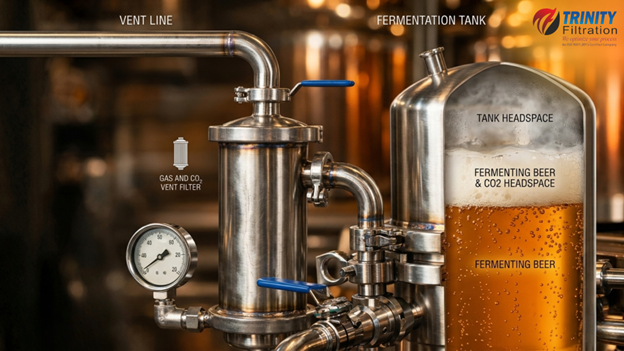
Fermentation and conditioning tanks breathe. As temperatures shift and liquid levels change, air moves in and out of the vessel. If that air isn’t filtered, it’s an open door for airborne microorganisms, wild yeast, and mold spores.
This matters most during conditioning, when the beer is cold, potentially sitting under slight vacuum, and at its most susceptible to contamination. An unfiltered tank vent at this stage is a risk that’s easy to overlook and genuinely costly when it goes wrong.
The audit question here:
Do all your fermentation and conditioning tanks have hydrophobic vent filters, and are they being replaced on a proper schedule?
One thing worth watching: vent filters that have become wet lose their hydrophobic properties. A saturated vent filter doesn’t breathe properly, it either restricts airflow or, worse, allows liquid contamination to pass through. Checking vent filter condition regularly is a small habit that prevents big problems.
Stage 4: Post-Fermentation Trap Filtration
After fermentation and any primary separation step, centrifuge, DE filter, or similar, the beer still carries a residual load of yeast cells and filter media fines. Trap filtration’s job is to reduce this burden before the beer moves on to clarification.
Think of it as preparation work. If this stage is skipped or underperforming, your clarification filter receives far more than it was designed to handle. It clogs early, throughput drops, and you’re changing filters far more frequently than you should be.
There’s also a flavor angle here. DE filter media and other fines carried over from primary separation can cause off-flavors and contribute to turbidity if they make it through to the finished beer. Trap filtration catches them before they become a problem.
The audit question here:
Is your trap filter rated appropriately for your typical post-fermentation load, and are you changing it based on differential pressure monitoring rather than a fixed schedule?
Stage 5: Clarification
This is the stage that defines a beer’s visual character and, more importantly, its long-term colloidal stability. And it’s where the most significant technology gap tends to exist in brewery filtration setups.
Clarification isn’t just about removing yeast. It’s about removing the submicron colloidal particles, polyphenol-protein complexes, that standard mechanical filtration can’t catch. These particles are what cause haze to develop in the bottle weeks after packaging. Getting them out requires electrokinetic adsorption, not just sieving.
Modern enclosed lenticular filtration systems do both: mechanical depth filtration for larger particles and charge-modified media that electrokinetically attracts and holds sub-micron colloids. The enclosed housing also eliminates dissolved oxygen pickup, which, as we’ve covered in our previous blog on haze science, is the primary driver of permanent haze development.
The audit question here:
Is your clarification system actually addressing colloidal haze or just yeast haze? Are you measuring turbidity before and after to verify it’s performing as expected?
If you’re still running an open plate-and-frame press, this is likely the single highest-impact upgrade available to your filtration system.
Stage 6: Final Sterile Filtration
For non-pasteurized beer, this is the last line of microbiological defense before the product is sealed in a package. Its job is to remove any residual spoilage organisms, Lactobacillus, Pediococcus, and wild yeast, that survived everything upstream.
Here’s the thing about sterile filtration: it’s only as effective as the stages before it. If clarification hasn’t done its job properly, the sterile membrane receives a colloidal load it wasn’t designed to handle. It clogs prematurely, which either forces an early changeover or, worse, leads someone to push the filter past its reliable performance window.
The audit question here:
Are your sterile membrane filters integrity-tested before each production run?
This one matters more than most people realize. An integrity test confirms that the membrane is intact and performing to its rated specification. A sterile filter that hasn’t been integrity tested isn’t a sterile filter; it’s an assumption. For a non-pasteurized product with a meaningful shelf life, that assumption carries real risk.
Stage 7: Packaging Line Protection
The filling environment is the final vulnerability in the chain, the point where beer transitions from a controlled, closed process into a sealed package. And it’s a stage that often doesn’t get the filtration attention it deserves.
Sources of contamination here include filling heads, rinse water, ambient air in the filling zone, and CO₂ used for purging bottles and cans before filling. Even a beer that’s been brilliantly clarified and sterile filtered can be compromised if the packaging environment isn’t properly controlled.
The audit questions here:
Is your rinse water being filtered before it contacts bottles or cans? Are purge gases filtered? Is there a sterile vent filter on your buffer tank?
Spunbond cartridge filters are the practical workhorse for utility water at this stage, cost-effective, reliable, and sized for the kind of high-flow, continuous-use environment that packaging lines create.
Running Your Own Filtration Audit
You don’t need a consultant or a production shutdown to do this. What you need is a systematic walkthrough and honest answers to some straightforward questions. Here’s a simple framework:
Map every contact point: identify every stage where a fluid or gas touches your beer or a beer-contacting surface.
Check what’s in place: at each point, what filter exists? What type, what micron rating, what housing?
Evaluate fit: is it the right technology for what it’s being asked to do? Is it sized correctly for your actual flow rates?
Review your change-out records: are filters being changed based on differential pressure and performance data, or just on a fixed calendar schedule regardless of actual condition?
Identify unprotected stages: these are your highest-risk points. Prioritise biological contamination risks first, then colloidal and clarity risks, then operational efficiency.
The Gaps That Come Up Most Often
For what it’s worth, here are the findings that come up most consistently when breweries actually sit down and do this exercise:
Utility water going unfiltered into bottle and keg washing. Tank vent filters that are wet, clogged, or missing entirely. No trap filtration between the centrifuge and clarification. Sterile membranes running without integrity testing. Clarification filters are being asked to handle yeast loads they were never designed for. Dissolved oxygen going unmeasured at transfer points. And filter change-outs happening on fixed schedules rather than being triggered by actual performance data.
None of these are catastrophic on their own. But together, they add up to a process that’s more exposed than it needs to be, and more expensive to run than it should be.
Filtration isn’t glamorous. It doesn’t get talked about the way fermentation science or hop selection does. But it runs through every single stage of your process, and gaps in it show up in your yield numbers, your return rates, and your customers’ glasses.
A complete filtration audit is one of the most practical things a brewery can do, not because something is necessarily wrong, but because knowing your process end-to-end is how you keep it that way.
If you’d like a guided audit of your brewery’s filtration setup, Trinity Filtration Technologies’ Application Engineering team works directly with breweries to assess each stage and recommend solutions built around your specific volumes and process.
Get in touch: info@trinityfiltration.in